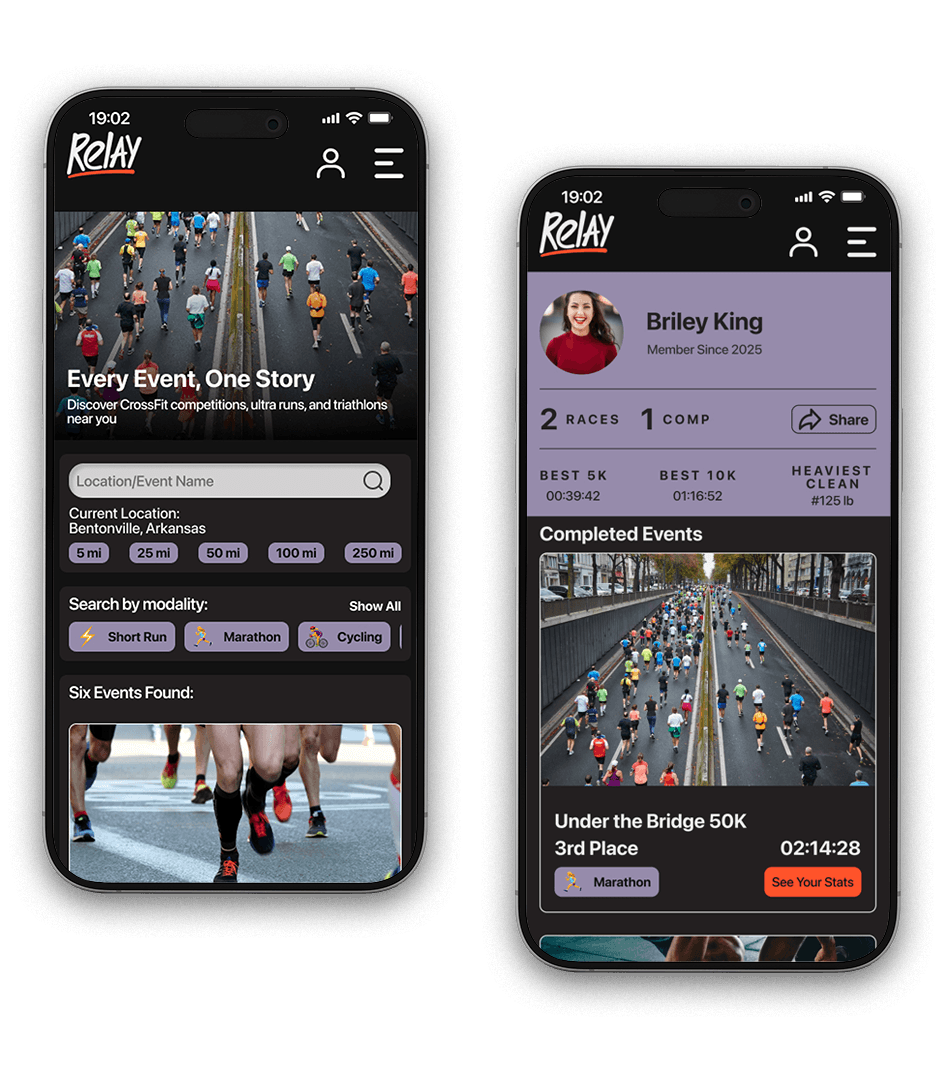
Project Overview
Athletes were juggling three–five platforms to find and track events. This created friction, missed races, and fragmented progress tracking. Relay consolidates discovery, registration, and performance tracking into a single platform.
Timeline: 6–8 weeks
Key Impact
Simplified multi-platform event registration into a single, streamlined flow. This reduces decision fatigue and makes it easier for athletes to commit to events.
My Role
Key Goals
View and manage athlete's past and future fitness events
View a list of up-and-coming fitness events
Register for event right there on the page itself
A simplified sign-up process
Results
Relay demonstrates the potential for a unified fitness event ecosystem, one that not only connects athletes to races, but keeps them engaged in what comes next. Through research, user interviews, and iterative testing, we translated key user needs into measurable improvements.
Users completed event discovery and registration without assistance during usability testing, validating the platform’s clarity and flow. We reduced the number of steps required to register for an event from 4 to 2, streamlining a previously fragmented process. Additionally, user feedback indicated improved clarity when tracking multiple events, helping athletes better understand their past performance and plan future goals.
Together, these outcomes show how simplifying discovery, centralizing tracking, and surfacing meaningful insights can create a more intuitive and motivating experience for both athletes and organizers.

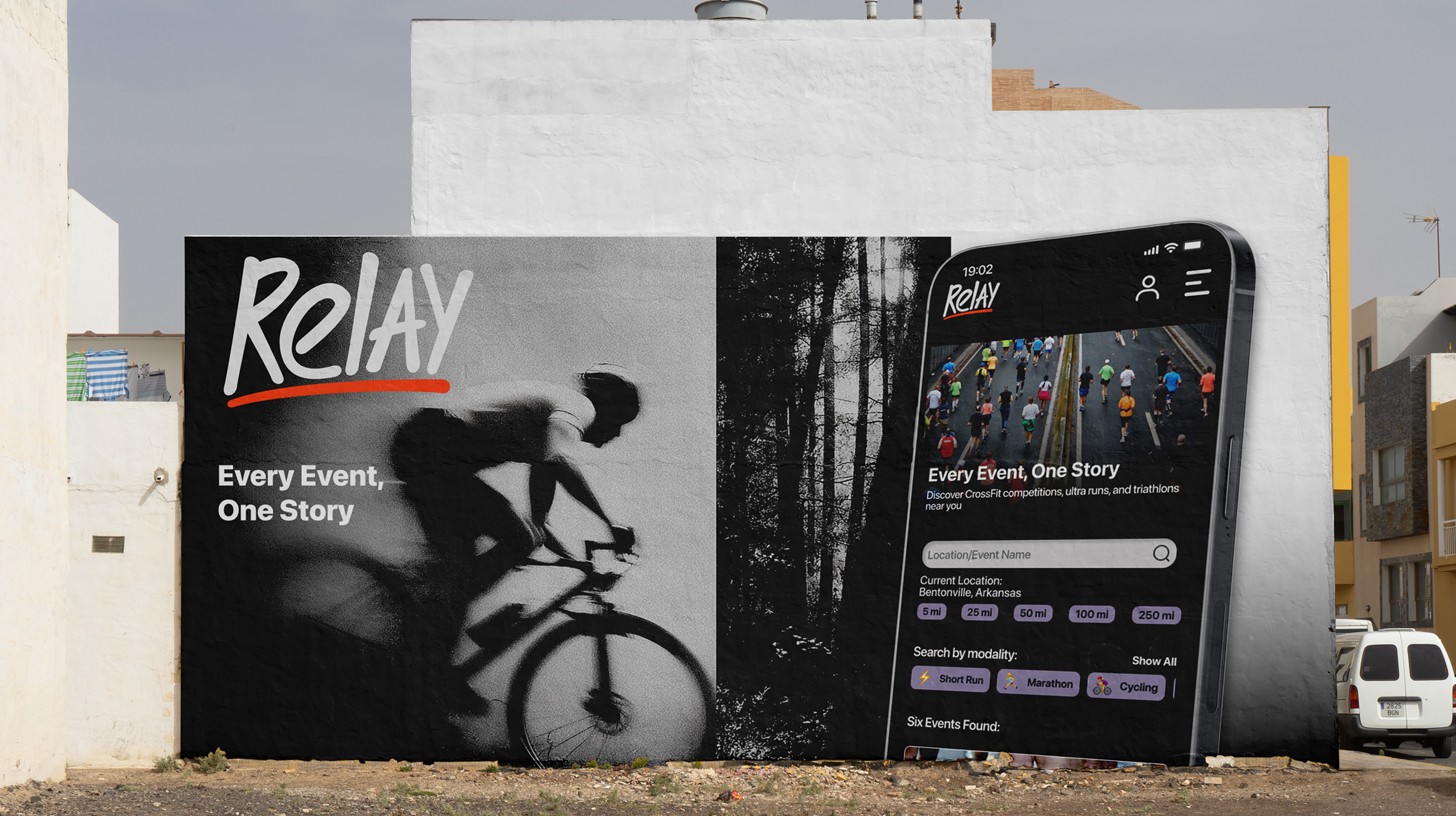
Research & Insights
We kicked off the project with research interviews with athletes and organizers who have had experience and pain points through signing up for events and organizing events. From there, we explored online research.
Our Research Goals were as follows:
Determine what websites customers use to register for races and competitions.
Understand how registrants promote their events and gather participants.
Determine how to simplify and streamline participants registration for multiple events.
After synthesising our insights, we developed a clear strategy and action plan to achieve our goals.
Competitive Analysis
To understand the competitive landscape, I analyzed six platforms operating in the fitness event space: Find A Race, RunSignUp, USA Cycling, CrossFit.com, My Fit Event, and Strava. A key finding was that four out of six platforms were entirely modality-specific, meaning runners, cyclists, and CrossFit athletes each had to navigate their own separate ecosystems to find and register for events. Nearly half of endurance athletes reported discovering events through fragmented sources like search engines, social media, word-of-mouth, and scattered registration platforms. This suggested many regularly missed races or late registration. The strongest competitor, Find A Race, offered a polished UI and broad race discovery across running, cycling, and triathlons, but still lacked CrossFit events and location-based search. Others like USA Cycling held authoritative data but suffered from poor usability and difficult event discovery. No single platform allowed a multi-sport athlete to find, register for, and track events across disciplines in one place and that gap became Relay's core competitive advantage.
Affinity Map
Users struggled with fragmented event discovery, unclear navigation, and low subscription transparency. This highlighted the need for a centralized, intuitive platform that builds confidence and clarity.
How might we help athletes track both past and upcoming events across multiple fitness modalities so they can clearly see and reflect on their fitness journey while planning for future goals, while at the same time simplifying the event sign-up process and creating a seamless experience?
Personas
After conducting interviews and based on the key demographics summary we were able to create our User Personas to find our ideal candidate.


Product Features
Based on insights from research, competitive analysis, and the user personas, I created a set of priority features to ensure user needs were met.
Origin of location on map — A map (using Google Maps or equivalent) showing where events are related to user geo location
Search feature — User searches for specific name of comps and events or location they may be traveling
Filter by modality types — With all the different modality types (Tris, runs, CrossFit), users will need a way to filter through so they only get the fitness comps they want
Filter by map radius — How far out do you want to travel or show the events happening "in your area"
Account Sign Up — User registration, sign in, and account page so the user can access all their relevant and specific data
Event Listing — List of up-and-coming races/competitions
User's Previous Comps/Races — List of past events
Registration to Event — A feature so that participants can register for the event listed
Show three modality tracks — Run event, Cycling event, and CrossFit event
User Profile Page — Since each user will have their own account, they will need their own profile
Information Architecture Decisions
To reduce friction in event discovery and tracking, I simplified the platform into four core areas balancing the needs of both athletes and event organizers while minimizing navigation complexity.
Home — Event discovery and search
Profile — Performance tracking across events
Settings — Account and preferences
Hosting — Organizer tools for event creation
Flow Design & Task Simplification
To map the end-to-end experience, I designed user flows that capture how athletes discover events, register, and manage their activity within the platform. Breaking this down further, I focused on key actions such as signing up for events, hosting events, and tracking performance. These identified friction points, reduce unnecessary steps, and ensure each path felt intuitive from start to finish.
Event registration flow improving clarity and completion.

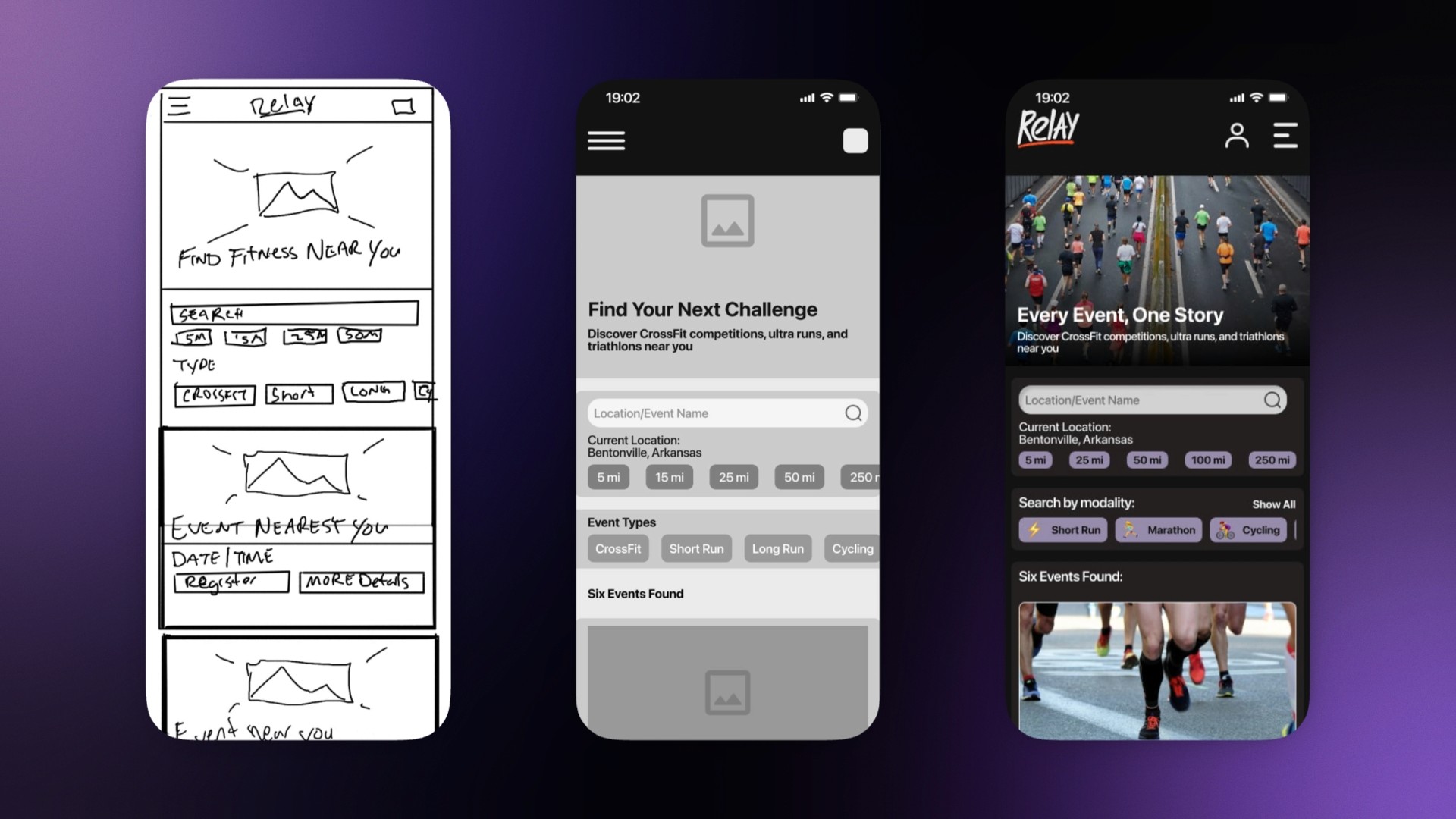
Wireframes
Starting with early wireframes, I iterated toward high-fidelity designs refining layout, interactions, and visual hierarchy to simplify key user flows. Each iteration focused on reducing friction, improving clarity, and aligning the experience with real user needs.
Branding and UI
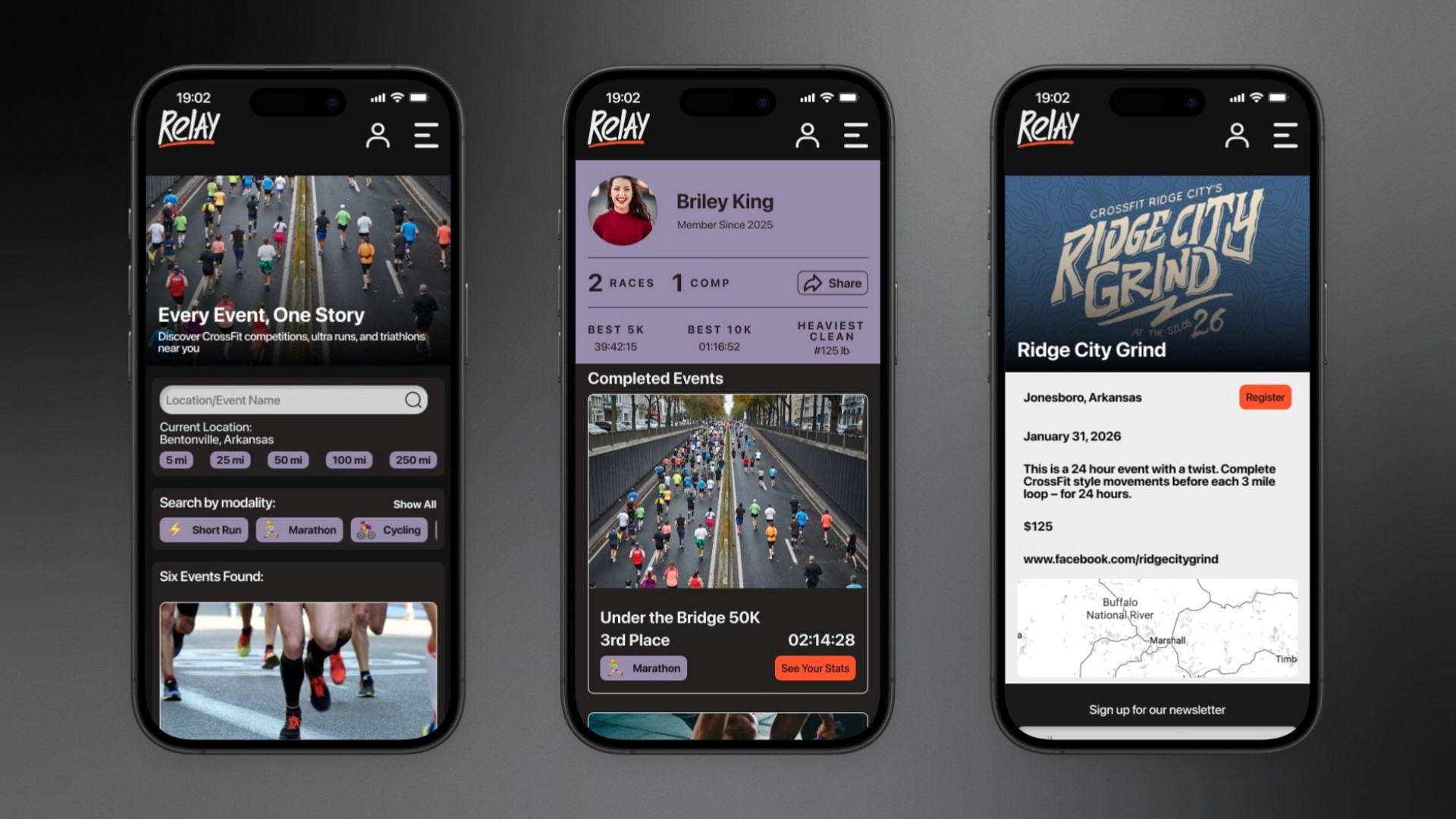
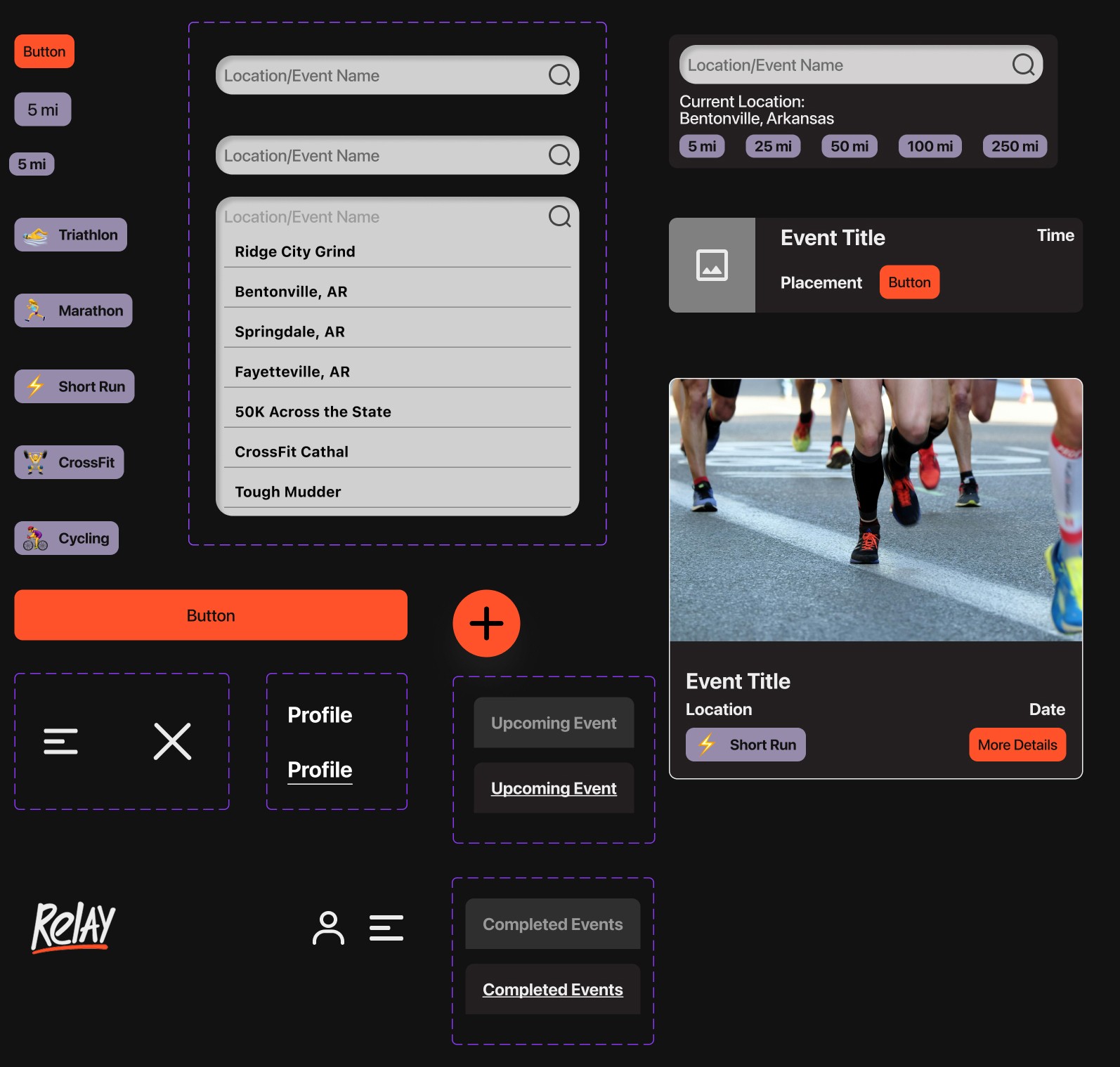
Relay is designed around momentum, helping athletes move seamlessly from past performance to future goals. The visual system reinforces this through high-contrast UI, clear hierarchy, and a focused color palette that prioritizes readability and quick decision-making during event discovery and registration.
Accent colors are used sparingly to guide attention to key actions, while a structured typographic system ensures clarity across dense event and performance data.
#121212
#FF522A
#968BAB
#EEEEEE
The color palette uses a dark foundation to prioritize contrast and readability, with a restrained accent color to guide attention toward key actions like search, filtering, and registration.
SF Pro Display
H1
Bold
26 Pt
H3
Bold
16 Pt
P1
Medium
16 Pt
P2
Bold
14 Pt
SF Pro was chosen for its clarity and familiarity, supporting quick, effortless reading across the interface.
Summary
For endurance athletes, tracking competitions often means juggling multiple platforms, spreadsheets, and fragmented tools. Relay simplifies that experience by bringing event discovery, registration, and performance tracking into a single, connected system.
Through research, user interviews, and iterative testing, these needs translated into measurable improvements. Users completed event discovery and registration without assistance during usability testing, validating the platform’s clarity and flow. We reduced the number of steps required to register for an event from 4 to 2, streamlining a previously fragmented process. User feedback also indicated improved clarity when tracking multiple events, helping athletes better understand past performance and plan future goals.
By simplifying discovery, centralizing tracking, and surfacing meaningful insights, Relay creates a more intuitive and motivating experience for both athletes and organizers.