About Featured All Work Contact

Personal Product · Finance

Sentry

A budgeting app I designed and built for my family, so I could actually see, and touch, where our money goes.

Product Design Full-Stack Build Ask Sentry AI
2
Users, My Wife and I
0
Bank Connections, Entered by Hand
v2 Live
Tax Layer and CSV Export

Viewable Product →

The live demo is open to the public and runs on a fictional household's sample data.

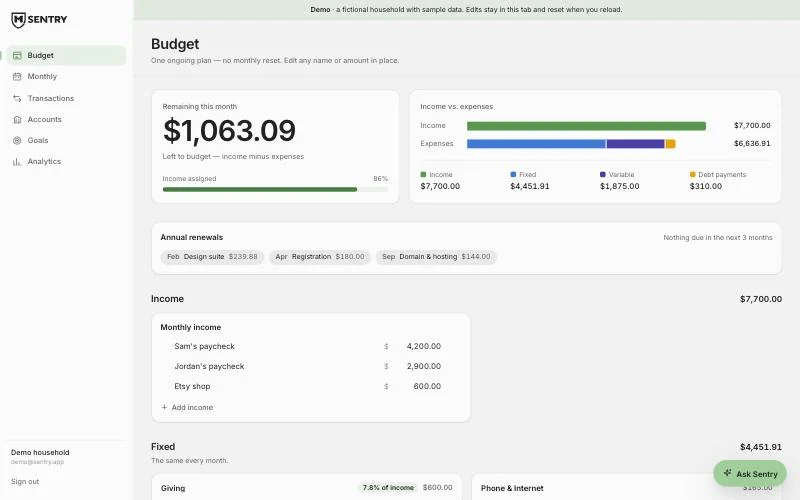
Sentry, the Budget dashboard with income, fixed, and variable spending

Why I Built It

Our Money Was Working, I Just Couldn't See It

Our finances were fine on paper, but I was stressed because I had no feel for how our money actually moved. I'm a designer and a tinkerer, and I don't fully grasp something until I touch it with my hands, so I built the tool I wanted.

"Our finances were working, but I had no idea how our money was working. So I built something I could put my hands on."
Friction Someone Else's App Off-the-shelf budgeting apps were never fully customizable. As a designer, I couldn't trust a picture of our finances I wasn't allowed to shape.
→
Solution I built my own, so every view, category, and rule matches how my wife and I actually think about our money.
Friction Bank Sync Has a Price and a Gap API connectors cost money and only link major institutions. Our small-town bank wasn't supported, so an automatic feed was never going to be complete.
→
Solution Manual entry. It works with any bank, and entering each transaction means I physically see and know where every dollar went.
Friction Answers Buried in the Data Questions like "how much did we spend on groceries this month" meant combing the ledger with a fine-tooth comb.
→
Solution "Ask Sentry," an AI assistant that reads our Sentry data and answers in plain English, so the number comes back in a sentence.
Friction Freelance Income and Tax Time Freelance income and write-offs lived outside the budget, so every tax season turned into a scramble to reconstruct them.
→
Solution A v2 tax layer: mark freelance income as taxable and transactions as write-offs, then export a CSV to hand straight to my CPA.
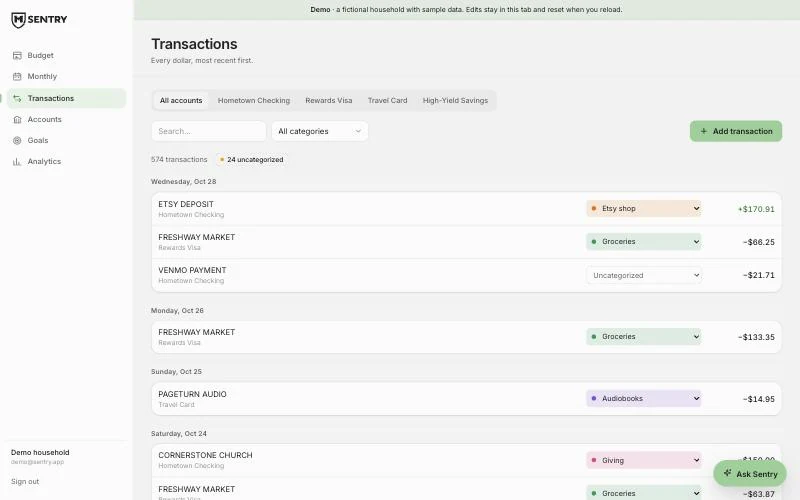
Sentry, the Transactions ledger with manual categories per row
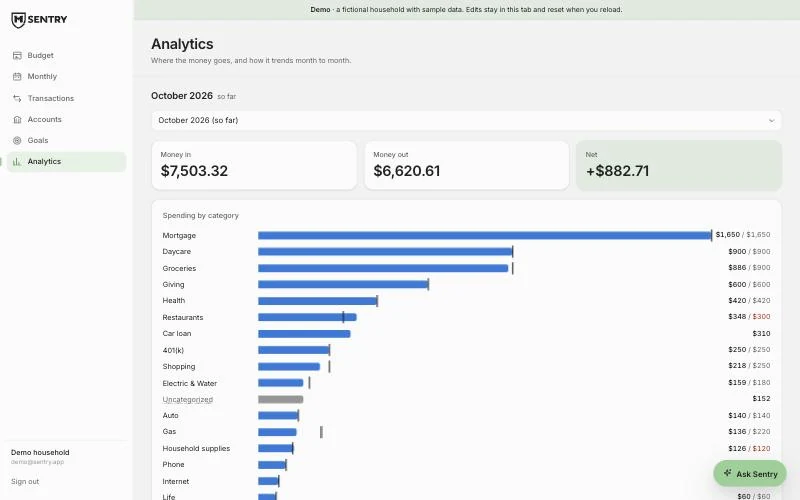
Sentry, Analytics showing spending by category against the budget

Ask Sentry

Our Numbers, in Plain English

"Ask Sentry" is a Claude agent, on the Sonnet model, wired to read-only tools over our Sentry data. It can look things up and answer, but it can't change anything, and the numbers it cites are the real ones from our ledger.

Read-only by design

The agent only reads what's in Sentry. Ask "how much did we spend on groceries this month" and it looks up the answer with its tools and replies in a sentence, using only the numbers those tools return.

No more fine-tooth comb

Before Ask Sentry, every question was a manual tally. Now the ledger answers back, which is the whole point of keeping it by hand in the first place.
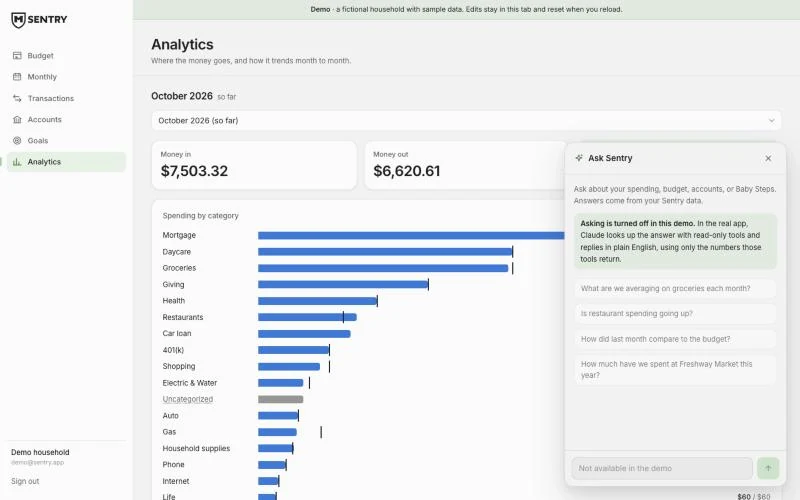
Sentry, the Ask Sentry panel answering questions from your own budget data

Decisions Worth Defending

Why It Works the Way It Does

Manual entry over bank sync

Connectors cost money, skip small banks, and put a layer between me and the money. Typing each transaction is slower on purpose, it keeps me in contact with every dollar.

Built for two, not for sale

Sentry is just for my wife and me. Scoping it to one household keeps it honest and simple, I can design for exactly how we live instead of a hypothetical user.

The AI reads, it doesn't act

Ask Sentry can see everything and change nothing. Money data is the last place I want an assistant improvising, so its tools are read-only.

Taxes export, they don't file

The tax layer tags income and write-offs and hands off a clean CSV to my CPA. Sentry does the tracking it's good at, and leaves the filing to a human who's good at that.

Shipped

What's in It

Viewable Product →

Open to the public. The demo runs on a fictional household's sample data; edits stay in your tab and reset on reload.